Home
Features
Croakwood
As calm as a lily pad
If, like me, you navigate life constantly thinking about Chicken Run, you too might anticipate at any moment discovering that the animal kingdom is actually populated by hardworking, town-building creatures. Though hopefully they won't try to assault and tie us up if they're ever discovered. Especially when the towns they're constructing appear as charming as those in frog townbuilder Croakwood. I could observe their activity and commotion all day.
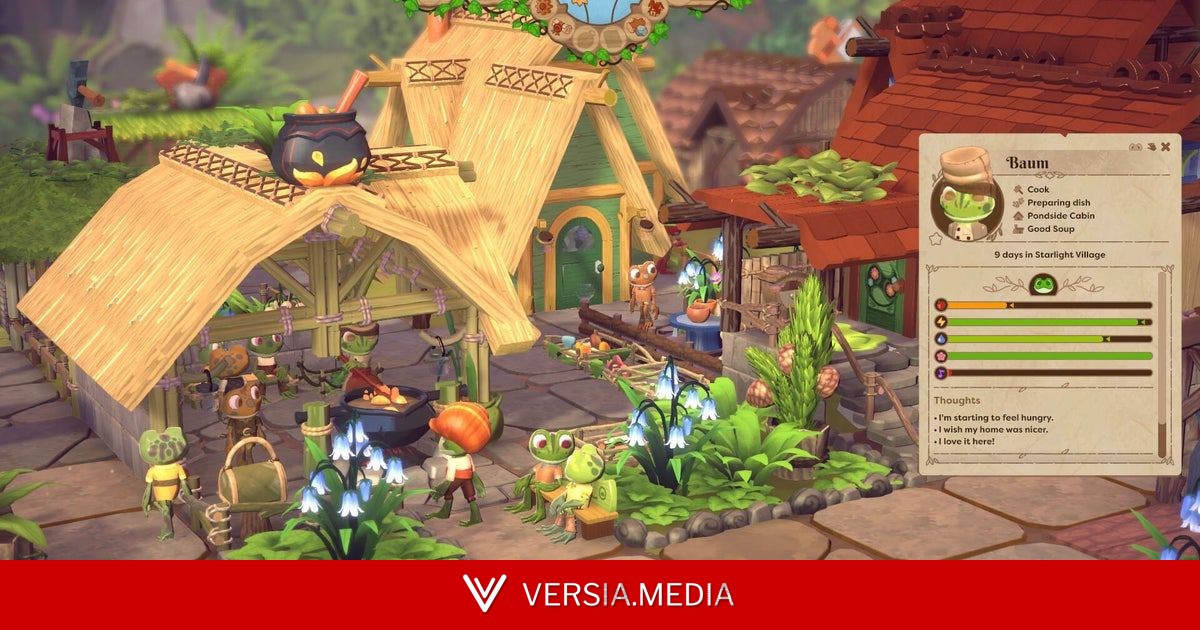
The upcoming game from Parkitect developer Texel Raptor, Croakwood places you in the position of mayor and urban planner for a tiny frog community. Concealed beneath the leafy canopy surrounding a small pond, the amphibian settlement would be simple to overlook as you wander through their woodland. Particularly when you consider the frogs themselves are just a few centimeters tall.
However, there's more happening in this townbuilder than initially apparent, as the developers have been investigating methods to capture the difficulty of a demanding management game without bringing the stress and pressure that usually accompany them.
After finishing work on Parkitect, a contemporary interpretation of the Roller Coaster Tycoon series emphasizing customization, developer Texel Raptor began prototyping their next project. Following various experiments with different genres, the concept they kept revisiting was a townbuilder. In those initial phases, the project had nothing to do with frogs; the team only knew two things, studio co-founder and artist Garrett Randell tells me: "We wanted to do something with a fantasy beauty to it and experiment with what a townbuilder is."
Co-founder and programmer Sebastian Mayer grew up playing The Settlers and the Anno games, but he discovered they consistently followed the same disappointing trajectory. "I loved the part in these games where you build up the economy, but I really hated that these games always ended in some sort of conflict," Mayer says. "It always ends in destruction and that was annoying to me because I just wanted to keep the economy going."
For Croakwood, Texel Raptor has been attempting to capture that expanding economy, with long-legged, amphibian villagers bustling between production facilities carrying goods, while also discovering ways to give you a reason for all that industriousness beyond constructing a war machine.
It says more about my perspective on management games that I hadn't considered playing Anno as a cozy experience. When work becomes stressful, I often reach for a game where you create and oversee a complex economy. Anno 1800 pushes all daily thoughts from my mind, demanding I concentrate on ensuring I'm producing the ideal number of shampoo bottles to keep my hotels operational and my tourists satisfied. It lures me into a state where all my focus is on my city's pathways, refining their actions.
However, Mayer says they weren't deliberately making Croakwood a cozy game, at least initially. "The goal wasn't really to make a cozy game initially," he explains. "It was just to make a game that doesn't have the military and that kind of leads into a cozy game."
The distinction between a game like Croakwood and the Anno series isn't its complexity, but the pressure it applies to you. "For me and the rest of the team, none of us like being time-pressured or forced into stressful situations," Randell explains. "For an economy game, that sounds strange, but the key to Croakwood is that you can take it at your own pace. Anno puts you in that Zen, where you're thinking about all of the moving pieces and you're really focused [on] solving all these problems, [and] that exists in Croakwood, it's just we don't force you to deal with it in a time-sensitive manner."
Whereas in Anno you're competing against other nations to grow your empire and pressured to keep your population content to prevent rioting and removal from power, in Croakwood the punishment is less severe. The town you're building will decelerate as frogs in snail-shell construction hats and overalls wait for deliveries and green-skinned fishmongers throw up their arms at the empty baskets in their shop, but they won't expel you from town. "Your villagers are going to nag you a bit more, and some might leave," Randell says, "but your town will never outright collapse."
And, to underscore the decisions made by Texel Raptor, removing combat doesn't automatically mean lower stakes. Just look at Whiskerwood, a similarly appealing townbuilder that (key difference) sees you build a town for mice. That, too, doesn't currently feature combat but there are much harsher penalties for miscalculating your economy. If you don't gather enough firewood or food, your poor mice will freeze in their homes or starve in their beds.
Though avoiding combat and high stakes, and keeping a townbuilder interesting proved a challenge. "Early on it was difficult to figure out the game design," Mayer says. "Once you take away the pressure from the conflict, you have to fill that with other stuff."
That stuff is delightfully customizable homes.
In Texel Raptor's early townbuilder prototypes, construction was straightforward: you would select pre-designed houses and place them in the world, like you would in a real-time strategy game. The problem, Mayer says, was "that was really boring." It was only when they integrated the building system from Parkitect that they discovered what was missing. "That added a lot and pretty much the entire game is built around that now."
To expand your town in Croakwood, potential residents will inform you what kind of house they're seeking. That might just be the essentials, like how large a plot it should be or how many windows it needs, but it can be more intricate. The frogs "have different personalities and different preferences," Mayer explains. "They will make requests like, 'I really want to have more plants in my house. Can you help me?' stuff like that."
Satisfying the needs and tastes of your frogs is the purpose for building your economy. You need to locate and research the goods, foods, and furniture that will keep your residents happy, expanding your economy with different trades to produce it all in sufficient amounts so no one decides to pack up and move to the next frog town over.
You can see from the recent trailer how much control you can have over the customization of each frog's home, and that depth should be what drives the later stages of the game. As someone whose two main joys currently are playing Anno 1800 and redecorating my flat, I can see the appeal.
Croakwood won't be out in early access until later this year, so until then I'll just have to go along the nature walk near my house, lifting up logs and pulling back foliage to try and catch a colony of frogs in charmingly homespun doll houses by surprise.